
We are “building” a shield for our forests by supporting volunteer forest fire protection teams
The NGOs Desmos, WWF Greece, and HIGGS are joining forces to provide practical support to forest fire volunteers—both in terms of equipment and training—thereby strengthening their efforts to protect our country’s forests.
The Program to Support Volunteer Forest Fire Protection Teams, implemented by MKC Desmos in collaboration with WWF Greece and HIGGS (Higher Incubator Giving Growth & Sustainability), is moving forward at a rapid pace. Already, the first 21 teams have received equipment that significantly enhances the safety and effectiveness of their 749 active volunteers. The support will be completed with equipment deliveries to an additional 29 teams before the start of the upcoming fire season, which begins in May. At the same time, numerous volunteers received specialized training in forest fire prevention and response, as well as in the restoration of burned forest areas.
This is a truly ambitious collaboration aimed at protecting our forests, carried out under the auspices of “Initiative 21” and with the support of the Athina I. Martinos Foundation, the Ioannis S. Latsis Public Benefit Foundation, and the National Bank of Greece.
Volunteer forest fire protection teams are consistently on the front lines of forest fires, making a vital contribution to the work of the relevant government agencies. For this reason, providing them with equipment and expertise is essential so that they can continue to serve as a critical link in the national forest fire protection system. In this context, 149 volunteer groups actively engaged in this field were invited to apply for the program, of which 98 responded to the evaluation process. To select the 50 groups to be supported, WWF Greece followed a proven methodology, utilizing questionnaires, personal interviews, and on-site visits, to understand the scope of the groups’ activities and accurately assess their equipment needs. This methodology enabled an in-depth analysis and identified, through specific criteria, the most vulnerable areas and groups. For example, groups were identified that either cover areas lacking state firefighting forces or where, objectively, their response is delayed due to distance, or are located in areas at high risk for wildfires or in fire-affected areas where natural forest regeneration is expected, in which case they need to be protected even more intensively by the teams.
Specifically, between June 2022 and January 2023, more than 80 on-site evaluations were conducted across the country, from Rhodes to Evros and from Samos to Kefalonia. For each team ultimately selected following this extensive evaluation, a fully customized support plan was developed, taking into account various criteria, such as: its area of operation and the geographical conditions that dictate different approaches to firefighting, each team’s operational tactics, and its current capacity in terms of equipment and personnel. In addition, particular emphasis was placed on requests that could have a multiplier effect in combating forest fires, such as, for example, the creation of foot patrol units and their appropriate equipment, so that they can also intervene in neighboring sectors, as well as the upgrading of emergency response vehicles. Based on these criteria, materials meeting the appropriate specifications were selected for each equipment category to achieve a substantial upgrade of each team’s capabilities, with a primary focus on personnel safety.
At the same time, the first series of training workshops took place between April and May 2022, with 53 volunteer groups from various regions of the country (Attica, Samos, South Aegean, Western Greece, Peloponnese), while the second round of workshops began in January. The goal is to provide volunteer forest firefighters with specialized knowledge on forest fire prevention and response, significantly enhancing their safety during field operations. Additionally, through these workshops, understanding is enhanced regarding the particularly important role that volunteers play in protecting the natural regeneration of forest vegetation following a fire, as protecting these areas from new fires is imperative for many years after the disaster.
“This program has addressed fundamental and long-standing shortcomings in our association and will result in a better and more comprehensive contribution to our social work, as well as to the natural environment of our island, which has been so severely affected by forest fires in the past,” says Vasilis Zavitsanos, president of the Association of Volunteer Firefighters of Pythagoreio, Samos, one of the teams being supported as part of the initiative.
Similarly, Angelos Lyberis, president of the Association of Volunteer Firefighters of Agios Kirykos, Ikaria, stated: “The equipment we received has just arrived on the island of Ikaria and was put to use by our volunteers during the fire in Fournoi on January 6, 2023. This assistance has already proven to be extremely important, both for us and the safety of our members, as well as for the support we are called upon to provide to the fire department. This is especially true during periods of limited transportation access, when it is difficult to receive assistance from other areas. This initiative provides practical support to volunteers as well as essential support to the residents of remote islands.”
Michalis Kapetanakis, president of the “Ena” Volunteer Civil Protection Group of the Residents’ Association of Tria Monastiria in the Municipality of Rethymno, notes: “We received material support in the form of firefighting uniforms, helmets, gloves, and walkie-talkies that we so desperately needed. Participation in and attendance at training workshops on forest fire prevention and response, along with the aforementioned supply of logistical equipment, gives our volunteers greater capacity to intervene safely and effectively during their participation in future forest fire protection efforts.”
“Our participation in the program, the knowledge we gained in specialized workshops on forest fire prevention and response, as well as the forest firefighting equipment, enhances our effectiveness in the field and contributes to the safety of our members during fire incidents as a foot patrol unit,” said Vasileios Raptis, president of the Preveza Greek Paratroopers Club.
Finally, Panagiotis Englezos, president of ETHOMAK Salakos Rhodes, stated: “It is a great joy and honor for our team, but above all for our community, to receive material support from the Volunteer Forest Fire Protection Teams Support Program. It enables us to continue doing what we love, what sparked the creation of our team, what for us is our way of life—and that is nothing other than our voluntary service to our community. For the first time, this contribution is being recognized in practice; for the first time, words have turned into action, and for this we thank you from the bottom of our hearts and assure you that this support will not go to waste.”
In the next phase of the program, WWF Greece, in collaboration with the selected volunteer groups, will assess how the training and material support the groups received contributed to their work by monitoring their activities during the upcoming fire season.
The ultimate goal of this initiative is to contribute further proposals and conclusions aimed at improving the preparedness of the country’s volunteer forest fire protection teams in addressing forest fires and their consequences for both the natural environment and society as a whole.
- Notes & supplementary materials:
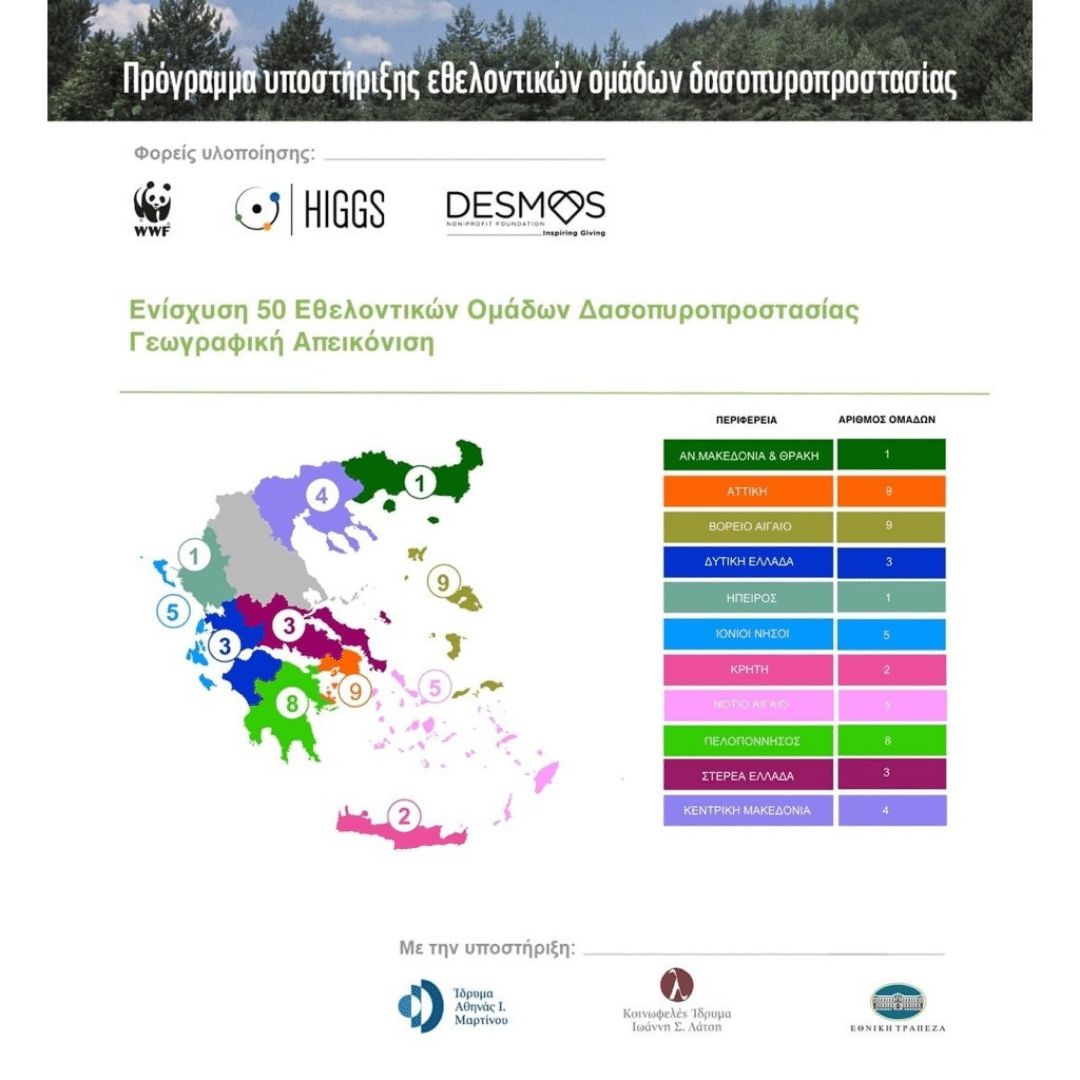
Photos of the material delivery, as well as a map showing the areas where the teams are providing support, are available here. - For a detailed list of the teams receiving support under the program, please see the
links below: The first 21 teams that received equipment in Phase A and the 29 teams selected in Phase B. - You can find information about “Protovoulia 21” here.
Media Contact: Christy Sotiriou, Press & Public Relations Officer, WWF Greece, mobile: 6947880699, c.sotiriou@wwf.gr

